Sunday, March 29, 2015

Drum remixes: a spice of extra flavor

Summary: There's nothing wrong with simple drumming, but remixes are a way to add a little extra to a song by spicing up the drums. Don't expect to be rewarded with thousands of views, though; from my YouTube covers and remixes, I've learned to make these videos because they're fun to play and look back on, as opposed to validation from viewers. This post starts with the history of how I got into drum covers and remixes, show the general outline of how I write a remix, and then share some thoughts that went into the Calvin Harris, The Spinto Band, and Lorde remixes.

History
It wasn't until eight years after I started drumming that I played along to an existing song. Until then, every solo session had been improvisation (though undoubtedly with influences from tunes on the radio or drum videos I'd seen online). Even my high school band, West Point Bridge, stayed away from the covers and preferred jam sessions where we'd improvise continuously for oftentimes twenty or thirty minutes. [On the left is a snapshot from June 14, 2006. We're all 15-16 here. I lost the hair right before college!] 

There was a certain naive pride to teaching myself and playing exactly what I wanted to play at any moment. If I played music I was comfortable with, mentally written a few moments before I played it, it was easy to feel like the best drummer in the world. The best example of this, I think, is improvising in randomly-selected time signatures. Switching from 7/8 to 15/16 to 5/4 is a lot less impressive when you didn't necessarily plan on it!

After my first live performance at a talent show in high school (which, I'll admit, was probably the happiest day of my life!), I got a few requests to put the video on YouTube. I didn't have an account yet so my brother put it up, but the thought of more performances, live or filmed, kept cropping up from the back of my mind. The summer after my freshman year of college, I decided to make my own YouTube profile and try drum covers. 

Playing along to Protest the Hero songs proved surprisingly challenging, fun, and rewarding. Learning the drums at a deep enough level to give them justice in a cover meant catching intricacies the drummer had written that I normally overlooked. Like little footnotes or scribbles in the margins of a book, they were little spices that often added a lot to the piece once I noticed them. Playing others' music, too, taught me to play more consistently and broadly. When I began, filming a one-take playthrough (i.e. no cuts to different angles or piecing together takes to overwrite mistakes) on a 4-minute song could take up to an hour because my playing had a large variance; sometimes I got that double-bass riff down but how well I did was a bit like rolling a die. Similarly, playing the occasional jazzy or psychadelic riff that made it into a Between the Buried and Me song was a nice reminder of other styles of music besides metal, and that popularity or drumming minimalism wasn't necessarily correlated with lack of satisfying drumming.

But sometimes other styles I listened to did seem to be woefully lacking tasty drums, like the drummer had played the essentials to keep the song going but had mentally checked out as soon as that was done. Learning these types of songs can take less time than the actual length of the song because they're so repetitive. This can be a sensitive topic: is it a lack of technical ability or creativity of the drummer (and if yes, is that a bad thing)? Is stepping back a conscious decision to keep the focus on the vocals, which more listeners will be paying attention to anyway? 

As a drummer, I can't help but pay more attention to the drums than the other instruments, so I really enjoy when drummers put in the effort to make them interesting. For a few songs I listened to, I felt adding a little to the drums would have a disproportionately larger improvement to the song, if not for the average listener then at least for those who paid attention to the drums. 

The last piece fell into place when I bought an electric kit in spring 2014. With access to studio-quality drum sounds without the headache of microphones, I was ready to try drum remixes.

General progression of a remix
1) Identify a candidate song
Good songs to remix have simple repetitive drumming that doesn't draw too much attention. An example is "Maps" by Maroon 5. The song's drumming is simple and enough in the background that it's easy to add extra elements without deviating too far from the core. The drums in a song like Taylor Swift's "Shake it Off," on the other hand, are too prominent to easily add to while still playing along. You either have to forget the original track and play something different, which sounds incongruous, or you have to devote a lot of your energy to playing the original track and then adding whatever bits you can on the side, which might sound like you're trying hard to just one-up the song.

2) Listen to the song... a lot
This might be an optional step, but I like having a pretty good understanding of the song and what additions, exactly, could sound good. What seems to be missing?

3) Play along to the song
Instead of focusing on one section at a time, I prefer to play through the whole song a few times, trying different interpretations out and making sure it flows well, before ironing out details in later revisions. This step goes a lot faster if I've done step 2 first. One thing to consider is that for some sections, playing minimalist drums is fine. Not every section needs crazy flourishes; playing in the background can help build up to the moments where you do show off.

4) Record it!
I usually walk in with a pretty good idea of what I'll do but with some few-second gaps in the plan. These spaces to improvise are usually automatically filled with playing that isn't by itself notable but that seems to fill well because it's being generated in the moment. I like having a bit of spontaneity in the final performance to make that take unique.

5) Post it and bask in the accolades... not really!
Posting drum covers and remixes on YouTube has been curious. Below is the time series of video views per day. (The first remix was on June 6, 2014, and the 300-view peak is from a live video of a Between the Buried and Me concert I posted the day after the show.)


A logical assumption is that the more videos I have, the more views (and praise) I'll get. Similarly, the better the playing or audio quality of the videos, the better the reception should be. Somewhat surprisingly, that hasn't been the case.

Even with the recent drum remixes being popular songs (as opposed to the more niche market of progressive metal), daily views have remained almost as low as when I started making covers at all. My bet is that the niche in drum covers and remixes has been filled by YouTube drumming stars like Luke Holland, Troy Wright, Alex Rudinger, Cobus, and Travis Orbin, all of whom have professional-quality audio and video and consistently put out awesome work. For me, the oftentimes lack of response to hours of effort in learning, performing, and editing a video just reinforces the importance of doing something for the sake of itself, not for a reward. Do what makes you happy because it makes you happy, not because you want the approval of others. 

Alright, enough generalizing. Here are some specific thoughts I had that went into my remixes of Calvin Harris, The Spinto Band, and Lorde.

Remix 1: Calvin Harris - "Summer"


0:32 - Ride cymbal build-up
I wanted something to serve as a build-up between the intro riff and the chorus, and I found I absolutely loved the addition of the ride cymbal. It parallels the piano notes and seems to add a bit of elegance to the nostalgia. Hitting the closed hi-hat on the fourth notes creates the build-up, especially with the mini release at 0:38 and then the open hits in the second measure. Adding the kick drum at 0:42 continues the build-up with the final release as the fill leading into the chorus.

0:46 - Alternating downbeat-upbeat chorus
The main synthesizer (starting at 0:39 and leading into the chorus) accents the downbeat so here was a logical opening to play with the downbeat and upbeat. The trick was to have smooth transitions between downbeat and upbeat so there weren't gaps in the notes; I did this by adding a bit of an extra punch in the crashes at 0:49 and 0:53. The kick drum is hard to hear at this part, but it's largely improv except for the upbeat. (The kick at this part is on the downbeat to accent the cymbals.)

1:16 - Downbeat toms and dancing on the ride 
When I play or hear this part, I think about excitement as a teenager, the fluttering piano being your thoughts and the toms almost like your heart as you're in the car heading with friends as you drive to a party. Thoughts of past loves, hopes of meeting someone new. The dance of conversation (and actual dancing maybe!) at 1:30 as you chase after each other. I play three versions of the "skip" on the ride here: R-L-R, R-LL-R, and R-R-R. This part was largely improvised and to keep the forward push on the kick drum, I lost a bit of focus on the ride and ended up doing the first version almost every time for the rest of this part. If I could redo the cover, I'd mix the "dancing" in this section up more, but I still enjoy it.

2:31 - Silence?
Especially when you focus on the drums in a song, it can be hard to admit that sometimes you should just sit tight and let the rest of the band move to the front. I didn't do too well; still had to throw in a snare roll at 2:42. :-) I tried building it up a bit with the hi-hat and then trickier snare patterns... but I'll be honest and say I usually stop listening to this remix around 2:00 because this section is kind of painful for me to listen to! With these drum remixes/covers, I always film them in one take, as a bit of pride but also to keep some authenticity of it being live drumming instead of highly edited. This was probably the 20th or 30th take and at some point, I'll just accept it and move on. Definitely still happy to look back on, though!

Remix 2: The Spinto Band - "Oh Mandy"


0:07 - Baseline riff and extra notes on the hi-hat
It took a few listens to this song to look past the (awesome) vocals/lyrics and ukulele to realize the drums play the exact same riff for nearly the whole song. Like in my "LAX" drum remix (a song that also has the same riff repeated for verses, chorus, etc.), I start the remix by playing this baseline riff before adding to it. I hint at more with the ghost notes at 0:14 and 0:17 before the small transition at 0:20. Here, I stop the constant kick drum and hi-hat 8th notes to open up space to add more. Throughout the rest of this part, I add in extra notes on the hi-hat to make it more interesting. Note the difference between hitting on the top of the hi-hat (concentrated note, e.g. 0:29) and edge of the hi-hat (bit more diffuse, e.g. 0:30).

0:49 - Ride 1 and push on the open hi-hat
This is the first of three ride riffs throughout the song that build in intensity. Here, I use the bell to create an accented pattern, throwing in a few extra notes on the ride and eventually hi-hat to make it more interesting. I debated what to play at 1:03 for a while; how could I make it flow but also add something? I decided to scale back the complexity and just play a simple pushing-forward riff on the open hi-hat. It's pretty straightforward, so I added a few extra notes on the kick drum and the stick tricks to keep it interesting. (Note: this part of the song is so happy/bittersweet. It's a lot of fun to listen to and play and I really got into it in the video!)

1:31 - Ride 2 and first cymbal explosion
The ride riff here is essentially the same as the Ride 1 but with more accents on the bell and a more prominent kick pattern. 1:45 was born in practices when I aimlessly tried adding more and more crashes to a ride riff, until I saw I could have an entire riff of crashes forming this uneven explosive wave. The trick was to have a simple kick pattern with a lot of space, allowing for me to focus on the hands. When it ends, 1:59 is like a heartbeat as you catch your breath.

2:06 - Return to origins and double hi-hat
I again wasn't sure what to have here: more complexity, more flourishes? I decided to go back to the original riff from 0:21, first on the hi-hat and then on the ride, with a few tiny additions. 2:27 mirrors the splashes (in the original, I kept waiting for the drummer to do this! Pretty simple and fun way to link up drums and ukulele) and builds intensity to the double-hi-hat riff. To avoid being repetitive with the kick drum but still having that "pushing forward" feel, I add and remove a few kick notes. When I first listened to this song, I kept imagining a drumming release here, as I see it as a focal point / climax of the song. I love playing the 16th notes on the hi-hat here because it feels like I'm adding to the energy.

2:49 - Ride 3 and finish
I accidentally hit the china (it's programmed to be the edge of the ride cymbal) at the start but I actually really like how it sounds. This final ride riff was improvised, and the little smile I get at 2:55 comes from this neat pattern of bell accents on the downbeat that was totally unintentional. (Maybe a bit of a translation: if you were to nod along the song, I unintentionally made a pattern of hitting the bell every time you were to nod.) Then at 3:02 the explosion of crashes again, but maybe with a bit more energy than the first time? Not sure, but I like this time around a bit more. Then with the hits on the snare and low tom, it's over. A breath of relief for what I happily realized was a playthrough with no mistakes and the improv turning out well!

Remix 3: Lorde - "Ribs"


0:00 - murky awakening
I first heard "Ribs" in a hostel in Berlin and downloaded it (legally from iTunes, no worries) to listen to again later. The train from the airport back to campus, after hours of traveling, sleepiness from jetlag, and some stress from getting back to work, formed the perfect conditions for being blown away by this song. I quickly realized I wanted to be part of the song, to add my voice with drums. The first thing was to make a drum version of this sleepy quagmire of thoughts at the beginning, like an embodiment of the few seconds before you wake up. To do this, I recorded a bunch of layers, from the rolls on the crashes and splashes to create a gentle background, to the notes on the hi-hat and ride that trip over each other and shiver as they build towards the "awakening" at 0:48. This is the first cover where I used a background light instead of the overhead room light to create a bit more intimate/safe environment. 1:02 bugs the crap out of me but it's too late to fix: trying to do the stick toss and keeping my eyes closed made me mess up the simple kick rhythm... but oh well. :-) I love the way the ride sounds at 1:09. The ride, and the entire ambiance at this point, feels intimate, like you're safely tucked away from the worries and stresses around you.

1:18 - tom build up and interlude
When I started writing this remix, I knew the loud clashes at 1:20, 1:24, 1:40 etc. would need a lot of attention so I used the china to accent them as much as possible. After the build-up, 1:33 follows Lorde's waves of thoughts and grows in intensity on the crashes as she shifts from withheld to assertive, yet still projecting that fear of growing up. At 1:49, I meant to cut all sounds from the cymbals but instead we're left with the declining wave of an earlier hit. It serves as a gentle transition, though, so I actually really like the effect. Now we're falling asleep in a car, consciousness just below the surface of the water. 1:53 is a whale beneath your feet, 1:56 sunlight on your face before a cloud darkens the water again.

2:04 - moving forward
To make a pretty standard beat a bit more interesting, I alternate the hard downbeat on the edge of the hi-hat with a soft upbeat on the top of the hi-hat. It kind of sounds like TSS-tut-TSS-tut-TSS-tut. Maintaining this DOWN-up-DOWN-up was pretty tricky during the splashes at 2:24... I won't say how many takes I messed up at this part! After some hints at fills on the hi-hat, 2:32 has a full fill on the top of the hi-hat. (Note the metallic clicky sound of the top versus the more TSSSS sound of the edge of the hat.)

2:34 - Calvin Harris beat and the tom build up
The ride/hi-hat build up is a pretty versatile beat, what can I say. :-) I like the addition here because I feel like it starts building a bit of excitement, like everything will be ok and we're getting in a car to drive with the windows down on a summer day. (Or is that 1:16 from the "Summer" remix...? Lots of shared imagery!)

3:04 - Galloping on the hi-hat, crash, and ride
The hi-hat gallop is a shift from the drums being largely in the background (except maybe the tom builds) to leading the section. Again, I wondered if I should try dressing this section up more (particularly with the straightforward kick drum), but simple is often better. These three riffs are linked by having a focus on the upbeat: the gallop is up-up-DOWN, the crash is UP, and the ride is UP-up. At 3:19, I'm imagining a shift in perspective from the nervous and scared girl afraid of growing up to one who's taking her fear head-on, hair blowing in the wind and chin up in defiance. It's hard, though; at 3:33 we have the delicate confession, fingers along the back, speaking in the darkness to the face next to yours in bed saying "you're the only friend I need." 3:49 is throwing open the curtains; you'll take this on, you'll make it through. As you look at the city lights below, you're telling yourself you'll be fine. And at 4:04 a hand at your shoulder, a hug from behind as you slowly close your eyes and relax. 

-Matt


YouTube channel: mgrobis

Friday, September 5, 2014

Perspectives on fieldwork in Africa

Africa. The very name brings forth visions of lush savannas, the origins of humans, and maybe David Attenborough's voice narrating a lion hunt. But it might also bring forth memories of news articles on political unrest, disease, crime. For a new researcher looking to work in Africa, it's difficult to gain an understanding of what the continent is really like before visiting. Fortunately, knowing people in the field helps! Here is an interview with two of my colleagues and good friends, Jen Guyton and Tyler Coverdale. Their answers are quite thorough so I'll let them do the talking from here on out.

Who are you? 

TC: I am a second-year PhD student in Ecology and Evolutionary Biology at Princeton University working with Rob Pringle. In my first year at Princeton I worked on several projects spanning my broad interest in community ecology and conservation. For my dissertation I am planning to work on several projects related to plant defense strategies and the impact of plant defense investment on plant-animal interactions and community structure. 

JG: I’m a second year grad student in Ecology and Evolutionary Biology at Princeton University, in Rob Pringle’s lab. Broadly, my interests involve the human-wildlife interface: how humans are impacting the role of mammals in ecological communities and how wild mammals and intact (or recovering) ecosystems can benefit humans. Currently, I’m studying the role of bats in providing ecosystem services, especially as predators of disease vectors such as mosquitoes. I’m also interested in zoonotic diseases and how poaching or hunting can be both detrimental to and critical for human health.

What is your field site like?
TC: I work at Mpala Research Centre (MRC) in Laikipia, Kenya. MRC is in the central highlands region of Kenya and is situated on approximately 75 square miles of private land at a little over a mile above sea-level. On my first trip to MRC two things stuck out to me: the landscape is very dry and the plants are very thorny. MRC falls in the rain shadow of nearby Mt. Kenya, which means that it only receives about 15-20 inches of rain each year (for comparison, New York City receives almost 50 inches of precipitation annually). What little rain does fall in this part of Kenya occurs in discrete rainy seasons, which sometimes “fail,” leaving the country in drought. The other dominant feature of the landscape is heavily defended plants – because there are so many herbivores (e.g. elephants, giraffes, zebras, etc…) many of the grasses, shrubs and trees in this part of Kenya have conspicuous physical or chemical defenses. The most obvious is the heavily defended Acacia genus, but many understory forbs and grasses also have striking adaptations for preventing and tolerating high levels of herbivory. It is a dusty and unforgiving landscape, which makes the diversity of plants and animals that call it home all the more amazing.

The Centre itself is comprised of a fenced compound containing labs, living quarters, a dining hall, administrative buildings and a workshop for car repairs. Graduate students typically live in the newly constructed, solar-powered dormitories (funded by Princeton) or more traditional circular bandas with thatched roofs. Meals are prepared by a team of local chefs and typically feature some type of grain (rice, ugali, or pasta) as well as a vegetable and/or meat dish. There are several laboratory buildings with bench space and desks available for visiting students and many of the long-term projects have permanent offices with all the necessary equipment to perform world-class field research. Each year Mpala hosts more than 400 visiting students and faculty for field courses, independent research and workshops. Many of the researchers come from universities in the United States, but there are also a handful of scientists from East Africa, Europe and Asia. The workshop has its own gas station for filling up research vehicles (mostly Land Rovers, Land Cruisers and a variety of smaller trucks and SUVs) and repairing flat tires that result from driving on rough dirt roads covered in 3-inch long Acacia thorns. Last year we had 13 flat tires in three weeks.

One of the many limestone gorges awaiting exploration in the
northern part of Gorongosa National Park, Mozambique.
Photo by Jen Guyton
JG: Gorongosa National Park, in Mozambique, is unlike anywhere I’ve been before. Imagine limestone gorges, unexplored by scientists, deep canyons filled to the brim with rainforest trees that seem almost as tall as the gorge is deep. Imagine clear springs trickling so thick with dissolved calcium that they fossilize the shells of giant land snails in less than 10,000 years – a blink in the eye of history. Imagine a place where every sunset is a blaze of crimson and lilac in shades that are not of this earth. Where red-leaved deciduous woodland turns over in an instant to towering yellow fever trees, their trunks like liquid uranium, in a dazzling display of landscape diversity. Where green plains stretch to the horizon and meet the tinsel-shimmer of Lake Urema, dotted all along the way with the prancing silhouettes of waterbucks and their calves. But the magic of Gorongosa isn’t in the megafauna – most of that was wiped out during the decades-long Mozambican civil war. What’s magic is standing at dusk in riverine forest, bush babies howling their human cry in the orchid-draped trees above you, when a rustle beside you entices you to gently crane your neck. It’s an elephant shrew, or sengi, a creature like a large mouse that walks on deer-like legs and has the wriggling snout of a tapir. The sengi, half of a monogamous pair, is snuffling through the underbrush in search of its dinner of crispy insects. It communicates with its partner by stomping the soil in morse code, its tiny feet tittering like a dog having its belly rubbed in just the right way. The creature looks at you with its inky saucers-for-eyes, adapted to see everything that happens in the forest in the blackness of night, and is gone. Gorongosa’s mystery and its allure lie not in its elephant encounters, which are better had and too easily won elsewhere, but in these moments for which your world must stop.

Those moments come almost daily when you start figuring out where to look, even inside the bedlam of Chitengo Camp. Chitengo is the park headquarters, the tourist lodge, and the research center all in one. The luxury resort has a pool and a restaurant at which we occasionally treat ourselves, but the research center is a treat in itself. Just opened this year, it’s a small cluster of wooden buildings, rising on flood-proof platforms among termite mounds and native trees. One tree even spears through the deck and the roof of the lab building, providing a quick escape for the lithe genet that sleeps in the building’s bowels. My room looks out over the woodland, and a few minutes spent sipping a gin and tonic on my porch is rewarded by sightings of bushbuck, civets, and the occasional bush baby. The porch light attracts all manner of insects, which in turn bring in my favorite mammals, the bats.

What is an average day like?
A large bull elephant walks in front of Mt. Kilimanjaro
at Amboseli National Park, Kenya. Amboseli is home
to some of the largest elephants left in Africa, and this
particular individual (Tim) has some of the largest tusks
of any elephant in the world.
Photo by Tyler Coverdale
TC: An average day at MRC starts when the sun rises around 6:30AM. Breakfast begins at 7:00AM and usually consists of milk, cereal and toast. Morning is also a great time to respond to emails, since Kenya is 7 hours ahead of the East Coast and I often miss emails that my friends, family and coworkers send during their work day. My field assistant arrives on a staff bus around 7:45AM and we aim to be leaving for our field site by 8AM with whatever tools and food we need for the day. We often pack a lunch to avoid having to return to the Centre since some of the places we work are more than an hour away. What we actually do in the field varies from day to day, but usually involves either setting up a large experiment or collecting data on an experiment that has been up and running for months or years. One of the experiments we set up this year involved cutting all the spines off of plants at the beginning of the summer and then revisiting them to measure how many of the spines had regrown and how much the plants had been damaged by herbivores. Despite being less than 1º north of the equator, the weather is great for field work: 80ºF with very low humidity and (usually) a consistent breeze to keep you cool. Dehydration is still very much a concern, though, and I usually drink between 3 and 4 liters of water each day to stay hydrated.

The work day ends around 5PM, at which point we return to the Centre to enter data into spreadsheets, clean tools and prepare for the following day. The afternoon is also a great time to work out since the sun is a little less intense and the temperature tends to drop a few degrees. MRC has a solar-powered gym with various cardio equipment and a dirt road the forms a 1 mile loop for jogging. Dinner is served at 7:30PM, after which there’s usually time for a few last-minute emails, data analysis and/or preparations for the next day before heading to bed around 10PM to repeat it all the next day.

JG: In Gorongosa, there are no average days. The only predictable thing is unpredictability. On a good morning, I wake up around 6:30, have some coffee and a bit of oatmeal with banana for breakfast, organize my field gear, pick up a field assistant and an armed guard, and get out the gate of our main camp by 8. The day goes smoothly, whether the task is vegetation surveys, collecting camera traps, or searching bat roosts. On a bad morning, I get up to see there’s no electricity to run the kettle or the stove for coffee and breakfast. I realize that someone has misplaced the key to the storage room where all of my equipment is. When I finally locate the spare and load the car, I notice the rear tire is flat. We change it, and I decide it’s probably a good idea to get more petrol. There is none in camp, so we have to run the risk of being stranded in the bush. By now it’s 9am and my field assistant isn’t here – turns out he’s gone into town. Because I haven’t had my coffee, I’m storming around the center like Godzilla. When we finally make it out of the gate at 10am, we encounter impassable mud/a tree fallen into the road/a herd of angry elephants… But eventually we get to our field site, and have a belly-laugh at the adventures and close calls. The bad mornings carve the good ones into sharp relief.

The ruins of Hippo House, a colonial-era restaurant
in Gorongosa National Park, Mozambique. It's a
fantastic place for catching bats.
Photo by Jen Guyton


In the afternoons, on bat-netting days, I’ll set up nets around 4pm. One of the best places to catch bats is over the swimming pool inside our main camp. Or, I’ll drive out to one of the seasonal ponds, another favorite spot for bats, or to the edge of the river or the lake. I’ll open my nets just before sunset. The hour after the sun sets is pandemonium – once, more than 30 bats hit my nets within 15 minutes between 6 and 7pm. Considering that each bat takes up to five minutes to untangle, that’s a lot for one pair of hands to handle – I ended up with a net like swiss cheese as the captured bats chewed their way out with teeth like tiny razors. Around 11pm, if I haven’t had a bat for a couple of hours, I’ll disassemble the nets and head back to camp. If I have any processing left to do, I’ll finish taking data from the bats and collapse into bed by 1am.

If I’m not mistnetting bats, I’ll join friends for sundowners (drinks at sunset) atop the ruins of Lion House. We sip a couple of Manicas, one of Mozambique’s signature brews, and watch herds of waterbuck grazing along the floodplain as they sink into silhouette with the ebbing glow. We drive back by headlight, pausing to watch a civet, a honey badger, or perhaps even a lion as it slinks into the bushes, blinking sleep out of its eyes. After a dinner of pasta and tomato sauce, and a little bit of preparation for the next day’s work, I get to bed around 10 or 11pm. I’m tired but satisfied, and drop into sleep amidst the wails of bushbabies.
  
What were your expectations for working in Africa before you left?
TC: I expected there to be a lot of differences between working in Africa and the previous work that I’d done in the US and Europe. Somehow the idea that working in Africa involved more hurdles, more hardship and more headaches had made its way to me and I was nervous about committing to five years of frustrating and difficult work. I knew that scientifically I would be entering a whole new world - all of my previous field experience had been in marine ecosystems and I’d now be working in the semi-arid savannas of equatorial East Africa. I was concerned about all of the unknowns: working with unfamiliar people in an unfamiliar continent on unfamiliar plants and animals. I tried to read as many papers as I could about savanna ecology while also searching for photos and videos of the places I’d be working in. I don’t like surprises, but my efforts to figure everything out before I left were futile and I got on the plane feeling nervous about what I was getting myself into.

JG: I first went to Africa at 19 with glossy magazine photos of acacias and red sunsets bubble-wrapping my brain. It didn’t take long to realize that the images of Africa that we grow up with, like so many other romantic notions, are half-truths. That first time, I went to Tanzania as a student with the School for Field Studies for an immersive course in wildlife management. I expected glossy photos. I expected to learn how to generate simple answers to wildlife conservation problems. I expected, or maybe I just hoped, like many bright-eyed youngsters shipping off to Africa, to change the world.

What surprised you most about working in Africa?
TC: My biggest surprise was that most of the rumors I’d heard (and worried about) just weren’t true. Working in Kenyan savannas was pretty much the same as working in salt marshes on Cape Cod or sand dunes in Italy. The thing about field work is that there are hurdles no matter where you work or what you study. For example, in the U.S. you have to worry about permits. Who owns the land you want to work on? Have you contacted all of the right people and filled out all the right forms? It’s the same in Kenya. The process is maybe even a bit easier here, because so many international researchers have done work here before and can point you in the right direction when it comes to dealing with the necessary (but unpleasant) logistics of doing field work. One of the rumors that I’d heard early on but can now dispel is that everything takes longer in Africa - in my experience, getting permits to do field work takes forever no matter where you work and patience will serve you well no matter what continent you find yourself on. Some things take longer here and some take no time at all.


A lion cub in the Lake Urema floodplain (Gorongosa
National Park, Mozambique) squints to keep tsetse
flies out of its eyes.
Photo by Tyler Coverdale  

The same goes for the work itself. I thought I could figure out what I needed to know about this new ecosystem by reading papers and sitting in my office at Princeton thinking deeply about elephants and Acacias. I hoped that a brilliant research topic would just come to me and everything after that would be easy. The truth is that here, just like anywhere else, you have to get out into the field and get a feel for the place. It takes a while (in my case, three trips lasting almost 4 months) to even begin to understand a new system, but it was the same learning curve I experienced earlier in my career when I began working in marine ecosystems. The similarities far outweighed the differences – the hardest part is still figuring out which questions are worth asking, followed closely by figuring out how to answer them.

JG: I found conservation in Africa to be vastly more complex than I’d anticipated; delineating more national parks and arresting more poachers isn't the answer (or at least, not the whole answer). “Africa” as we package it in the western sensibility is just a drop in a bucket swirling with unimaginable color and texture. Fortunately, I had a few more experiences in Africa (in
Breakfast: natal multimammate mice
(Mastomys sp), barbequed and fresh,
for sale at the market in Vila
Gorongosa.
Photo by Piotr Naskrecki,
thesmallermajority.com
South Africa twice, and then in Kenya) before I was thrown into the deep end of conducting independent research in Mozambique this year. In the interim I learned that conservation in African countries is insanely complicated. (I learned later that this is mostly true everywhere). One of the most challenging things was adapting to a palette of cultures; African countries tend to be much more heterogeneous than western countries. Each tribal or ethnic group has its own language, its own customs, its own angle. Understanding that diversity is crucial for good conservation, and if your work involves human subjects, for good research. 

To illustrate: I learned recently that hunting and consumption of rodents is extremely common in the villages around my research site. I was shocked – didn’t they know that rodents can carry some pretty nasty diseases? No – my field assistant told me with an incredulous laugh – It’s fine, Jen. They’re just mice. What you really have to worry about are crocodile brains. Deadly poisonous. Today I read an interview with a Beninese man who insisted that bats cannot carry Ebola: It’s just a rumor. Have you eaten bat before? It is very sweet. So how can anyone tell me that if I eat bat, it will kill me? When I dove into studying the human-wildlife interface in Africa, I wasn’t expecting that: to be up against a diverse suite of local beliefs. What’s true in this village may not be true in another. And each one of these things has a profound effect on conservation and on its scientific investigation. 

What is your favorite/least favorite part of working in Africa?
TC: My favorite part about working in Kenya is having the opportunity to do and see things every single day that most people will never be fortunate enough to experience. When I worked in the U.S., we commuted an hour each direction to our field site and experienced the kind of traffic that only arises when thousands of people are trying to cross a single bridge onto Cape Cod for their weekend of relaxation. Yesterday I drove an hour to my field site and the only thing that I had to stop for was to watch a baby elephant trying to figure out how to keep its trunk from flopping around as it walked away. The reason I started in ecology in the first place was because it afforded me the opportunity to work outside and be in nature every day. I've been fortunate enough to work in some of the most incredible parts of the world, but the wildlife and landscape in East Africa are stunning and memorable in a way that few places are.

My least favorite part about working in Kenya, aside from being away from friends and family, is constantly feeling crunched for time. Most of the grad students at Mpala only spend 3-4 months per year working in the field because of obligations at home and school. For me that means working sunrise to sunset every day to try to fit everything into one short trip. When I worked in the U.S. we routinely spent 6-8 months in the field every year. Here I’m expected to get the same amount done in half the time. It’s hard to drive back to Nairobi at the end of a trip knowing that you didn't quite make it to the bottom of your to-do list. The good news is there’s never a shortage of things to do on your next trip, provided that you can wait patiently through 9 months of teaching, grading and writing grants.

JG: My favorite part of working in Africa is the wildness. There remain whole tracts of land that have never been rigorously studied. New species creep their way into science from the

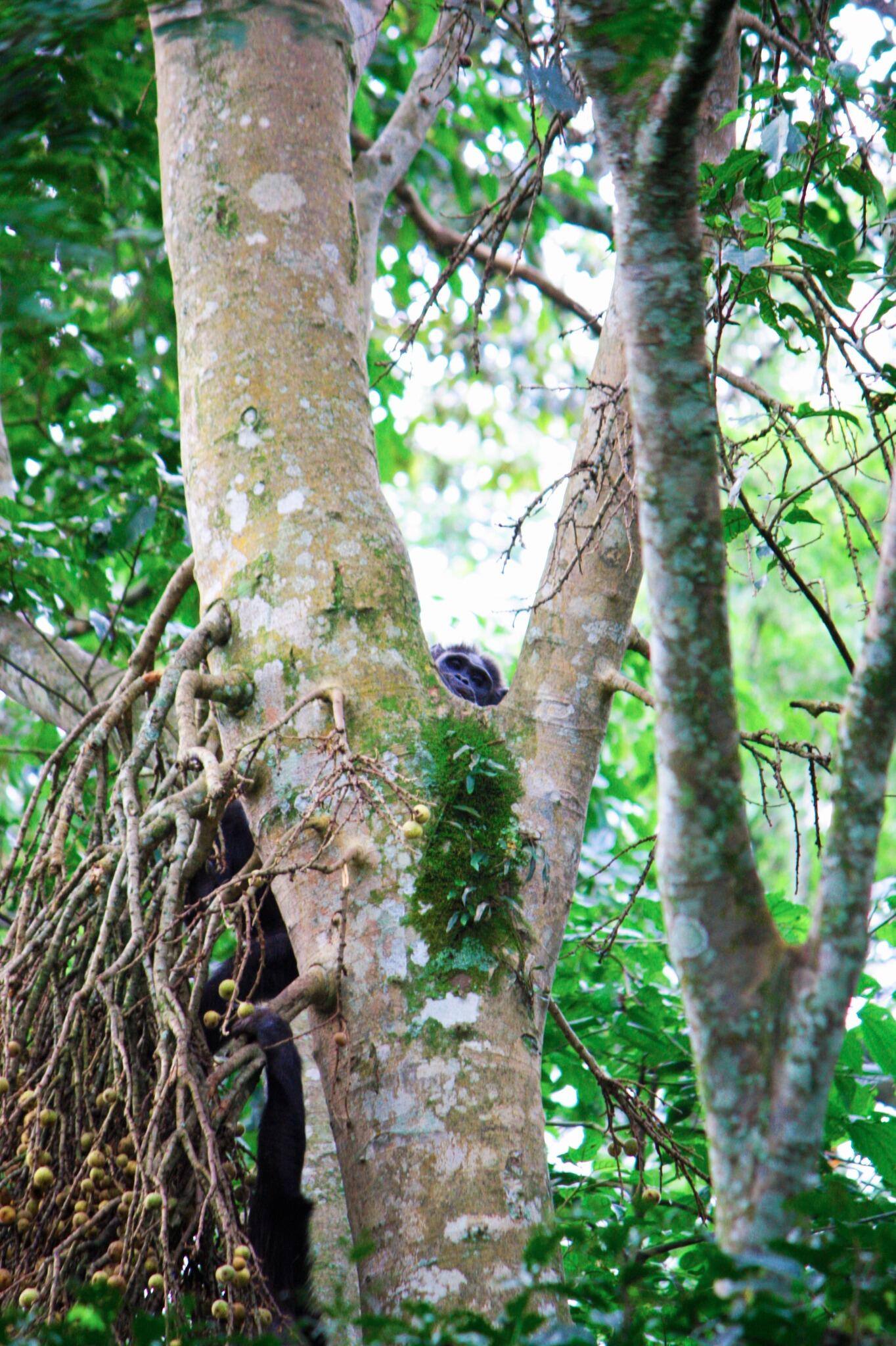
Sneaky chimpanzee hiding in a fig
tree at Nyungwe National Park,
Rwanda.
Photo by Tyler Coverdale 

rainforests and mountaintops on a regular basis. There is still so much to be discovered, and I get to be out there discovering things every day. Secondly, I’ll expose myself as a sap by admitting that I felt an instinctive connection to the continent the moment I set foot in Tanzania in my second year of college. It’s something that many people express feeling on their first visit to Africa. Some have hypothesized that it’s the siren song of our evolutionary home – the old country, the motherland. Perhaps we have an inborn affinity for the sweeping savannas for which we were once best adapted. Perhaps it’s the act of putting ourselves into pseudo-dangerous situations (tiny car vs. charging elephant, face vs. spitting cobra, and deadliest of all, human vs. human) that clicks us into place, a well-oiled evolutionary engine at maximum capacity and running smoother in that situation than in any you’ll ever find in civilization. Either way, the flame draws me back every time.

My least favorite part of working in Africa is navigating bureaucracies. As with any place, they tend to be unnecessarily convoluted, circular, and at times downright absurd. The difference is that in many African countries, individuals in bureaucracies have substantially more power. They have the power to push your paperwork through if you charmed them enough; the power to lose it if you haven’t; and the power to be (or at least pretend to be) totally and completely ignorant about their job, their organization, and the laws of the country. Getting research permits or visa renewals is the stuff of nightmares for most African researchers. If you want to see what I mean, mention the name “Nyayo House” to anyone working in Kenya (it’s now the Department of Immigration but was once used to torture political prisoners. In other words, nothing has changed.)

What advice would you give to someone who is thinking about working in Africa?
TC: For undergraduates thinking about working in Africa, I would suggest trying to find a field course or study abroad program that exposes you to what it’s like here while also providing some structure to your day-to-day life (e.g. Organization for Tropical Studies and School for Field Studies). It can be hard enough to work in a new place without also worrying about feeding yourself, arranging transportation and finding a place to sleep every night. Many universities also have their own field courses, but if yours doesn't I would also look into volunteering or interning with a graduate student or postdoc. That can allow you to get some field experience and see what it’s like to work on a “real” project without the pressure of coming up with your own research ideas (there’s also the added benefit of getting a glimpse of the graduate student life if you are considering graduate school yourself).

For graduate students, I think working in Africa can be hugely rewarding provided that you approach it with the right attitude and expectations. As with all field work, being flexible is critical to overcoming the small hurdles that seem to arise almost daily (e.g. waking up to a flat tire, finding that your experiment wasn't as elephant-proof as you’d thought). It also helps to be open-minded about what you want to work on. Whenever you work abroad it is easy to fall into the trap of writing the world’s greatest grant proposal only to find out that what you proposed just isn't feasible when you actually arrive at your field site. Most of the people who I've talked with out here are currently working on projects that are totally unrelated to what they thought they’d be doing six months or a year ago. That kind of flexibility will serve you well no matter where you work, but is particularly important when working abroad.

JG: Visit your region of interest early in your career if you can – undergrad is a great place to start, via study abroad or by jumping onto a research project (don’t be shy about asking around!). There’s nothing like being on the ground to get your scientific gears turning. Keep an open mind – sometimes local knowledge is more valuable than the published stuff. Learn as much as you can about local custom, and obey it whenever you can. It will earn you friends and spare you enemies. Learn early to dole out patience in gobs. Triple your sense of humor. Most of all, don’t be intimidated – the rewards (academic and personal) are far greater than the challenges.

Photo by Jen Guyton
Jen and Tyler can be reached at jguyton[at]princeton[dot]edu and tylerc[at]princeton[dot]edu. Check out the following links for more information.

Jen:
- Gorongosa National Park profile
- Sunbird Media
- twitter: jen_guyton

Tyler:
- Gorongosa National park profile
- Princeton website
- twitter: tylercoverdale


Thursday, June 5, 2014

PhD: 1st-Year Reflections

The first year of the PhD is over. Kind of. It's not technically your second year until the new first-years arrive in September, and the work hasn't suddenly stopped with the end of the semester, unlike in many course-based humanities PhD programs. If anything, this summer is when I'll actually make any progress on experimental ideas I've been developing since I first e-mailed my advisor two years ago. But enough time has passed that I think I can share some reflections on my first year that can hopefully help someone else starting or considering starting a PhD in biology.

A quick bit of background about Ecology and Evolutionary Biology (EEB) at Princeton to help frame this post, since EEB programs vary hugely across universities: 
- You are admitted to the department, not to an advisor
- There are no lab rotations
- You finish most of your course requirements in your first semester
- You teach a maximum of 4 semesters and you start immediately

During my first semester, I spent most of my time as a TA for a huge introductory bio course, read articles for the two graduate-level classes I was taking, attended weekly colloquia by visiting speakers, and read as many articles as I could to develop research ideas. In my second semester, I did a tropical ecology graduate research course in Kenya, analyzed the data and wrote up a presentation, read more articles and two textbooks, performed pilot experiments to get experience working with fish, spent several months writing and revising a protocol for proposed experiments to be approved by animal welfare, and attended the weekly colloquia. (But mainly across both semesters: I spent hours and hours figuring out what experiments to do and how to do them!)

What I thought grad school would be like during college
"Grad school is where you show up at noon, plan some experiments, run them the next day, then analyze the data. A PhD takes 5-7 years because it takes a while to plan the perfect experiment, one that hasn't been done before and that answers a hole in the literature. During your first year, you do 5-6 experiments and publish at least one of them."
When you're doing lab reports during college, it's almost guaranteed that the Discussion section will say something like "the study would benefit from more data." We had three hours to do the lab; imagine how good the data would look if we had three weeks? Then, during your senior thesis, you continually imagine being able to do your research without juggling hours of lectures and homework at the same time. Grad school seemed like a big expanse of time to think about experiments, try them again and again until they're perfect, and then publish. Any sub-perfect experiments were the fault of the experimenter not being motivated enough.

What I thought grad school would be like during the Fulbright
"Grad school is where you show up at 10am and try to figure out why the pilot experiments didn't work. A PhD takes 5-7 years because ironing out all the details of an experiment takes weeks of pilot work, running experiments and analyzing the data can take months, and many experimental animals only have certain times of year when you can run experiments on them. During your first year, you spend half the time planning and the other half the time running the experiments and troubleshooting."
(As some background: I worked at the Max Planck Institute for Ornithology for a year after graduating college, collaborating with a PhD student on a study on sleep in great tits and doing a pilot experiment on social foraging in the wild.) The sleep study required weeks of reading articles and planning, with its pilot taking about a month to perform, analyze the data, and get ideas for improving the final design. Preparation for the experiment took three months, the actual experiment took two weeks, and analyzing the videos took four months. Grad school, it seemed, would be a cycle of preparing for an experiment, performing it (successfully), analyzing the data, and publishing.

What I think grad school is like at the end of my 1st year
"Grad school has cycles. Sometimes you show up at 10am, read articles all day, teach yourself R, and go home early. Sometimes you show up at 8am because you need to run three trials of experiments, and sometimes you swing by at 2pm because you were up until 4am writing revisions for a manuscript due to the journal that day. A PhD takes 5-7 years because literally everything takes longer than you think it will, and nothing works the first time you try."
Something I didn't quite grasp during my senior thesis and the beginning of the Fulbright was how much others had helped in making the experiment work out. It's the difference between trying to find a store in a huge city you've never been in versus someone giving you a crude map and telling you roughly where the store should be. My advisor in college steered my thesis ideas towards a project that would answer a question regardless of what the results were, and my collaborator in Germany was the equivalent of a 4th-year PhD student in the U.S., meaning she'd had a lot of experience with figuring out the right way to do an experiment.

What my 1st year was like: 
You frequently feel like you know nothing
An incredibly common feeling in grad school is "hm... I'm not sure how to do this." The first reaction is to ask someone else, maybe an older grad student in the lab, or your friend who's a lot better at R or Matlab than you are (hi, Sinead). You just don't know the answer right now, so let's find it and move on. For our generation especially, Wikipedia and Google make the answers to most of our questions separated by merely seconds from when we decide we want to find out. Grad school, on the other hand, is about constantly being in this zone of wanting to know an answer but not having it. That's what research is; if we knew the answer, we'd have passed the info along to someone else (government organizations, the medical world, conservation groups, engineers, etc.) and be focusing on finding the answer to a new question.

As frustrating as it can be not knowing how to fit a quadratic curve on a scatterplot in R or who to e-mail for ordering new syringes for the lab, it is very satisfying the next time you have to do it and you know exactly how. And as you read more articles, go to more lectures, and talk with more people, you start seeing the same concepts reappearing... but this time, you understand them a little better.

You spend a long time figuring out how to find the answer to a question
Do you remember those "If you had a million dollars, how would you spend the money?" essay prompts in high school? One of the biggest hurdles I've had in planning experiments in grad school is getting out of this mentality of infinite money and time. You read about experiments where the authors make grandiose claims out of six data points and you vow to never publish something so ridiculous. If you're going to do science, you're going to do it right, even if it means fewer publications during your PhD. Your experiments will have at least 30 individuals, each assayed on multiple days to control for between-day variation in behavior, and each individual will be exposed to 5 treatment groups to see the full effect of the variable on behavior.

Those are fantastic intentions, and you can often make it work. But it's really difficult. If you're like me in college, "really difficult" sounds like something that applied to people who weren't you; you've faced "really difficult" before and gotten an A in the class. Let me reiterate: it is really freaking hard to do this.  

Here's an example from this week: I've started a pilot experiment to figure out how the social environment affects how skittish a fish is in a new environment. The idea is to use 8 fish in 3 different groups of 60 fish. Due to poor planning, the videos ended up really dark, and it's impossible to distinguish who's who in the video. Not only can I not use the data; if it wasn't for some quick thinking by marking all tanks where fish had seen the experimental tank, I might have had to scrap the experiment! (In animal behavior research, novelty to an environment is often extremely important.) So even though I've been planning these ideas for a few weeks, I nearly messed everything up within the first two days of actually doing anything. It always seems so obvious before you start, and then it never goes how you plan. (Above right is a video still from a trial I can't use.)

But... that's just how it goes. You can't get to the end result without making mistakes. And you can't make any progress if you don't try.  

You wait (a lot) for clearance to do research
Animal welfare committees are a crucial part of research by instituting ethical requirements for how research should be conducted. They ensure that the research has a bigger point and that your methods are the most humane way to get there (e.g. if mice have to be euthanized, what's the calmest and least painful way for the animals? If the crickets suddenly start dying during the experiment, what do you do?). If you're doing fieldwork, you need to get a license for the work; if it's in another country, you probably need a visa as well.

Ensuring that research will be done properly takes a lot of time. Animal welfare committees have panels of both scientists and non-scientists to get a range of perspectives on the ethics of the work, which means extra time is needed to exchange and explain the reasoning for different viewpoints. For fieldwork, a lot of people want government approval for permits or visas, and there are only so many people reading the proposals. The only advice I can give on this is to start early, be patient, and be courteous with your e-mails. The waiting time (on the order of months) can really help refine your ideas for when you actually start.

You start to understand what makes for an interesting scientific question
For the first few months of grad school, I told people I was interested in how group composition affects predator evasion behavior in schools of fish. It took a lot of thinking and discussing with others to refine those ideas into a broader framework with more applicability than one species of fish under one type of predation risk.

You spend a lot of time thinking in grad school. Your ideas have to stand up to hundreds of hours of mental chewing; the best ideas are the ones that not only hold strong but also generate new ideas the more you learn about them.

--------------------------------------------------------------------------------------------------------
Doing research has been challenging but I've been really happy so far. It's really quite amazing to be paid to think about and do experiments asking questions nobody in the world knows the answer to yet. I feel like the incredible amount of time stuck, trying to figure out an impasse, has taught me how to find the answers to things I don't know. This mentality has given me a lot of confidence to approach things I might have shied away from before because it seemed too difficult (e.g. teaching myself linear algebra, taking a metro or bus in a country where I don't speak the language, etc.). And most importantly, I constantly feel like I'm gaining a better understanding of how the world works, which only makes me more excited to see where grad school takes me.

-Matt

Monday, April 28, 2014

A model for the emergence of leaders and followers in foraging pairs

Animals have a lot to gain by foraging together. One of the biggest costs while feeding is having your attention focused on the food obscured by the rocks at the bottom of a river, or the prey trying to squirm away from you in the tall grass - and not on a predator that could be watching from just out of sight. Similarly, the world is a big place, and especially with mobile prey or ephemeral food patches, you might have to invest a lot of time to actually find food. Having other pairs of eyes scanning your surroundings while you eat or helping you find food is a huge benefit. Yet, how do socially-foraging animals actually decide when to eat as a group? Is it necessary for them to communicate their hunger state to each other? In a 2003 paper by Rands and colleagues, a very simple model for social foraging in a pair of animals showed that the mere existence of benefits to foraging together is sufficient to evolve synchronous foraging and 'leader' and 'follower' roles, even without knowledge on the state of your partner.

Article details
- Rands SA, Cowlishaw G, Pettifor RA, Rowcliffe JM, Johnstone RA. 2003. Spontaneous emergence of leaders and followers in foraging pairs. Nature. 423: 432-434.
- Corresponding author (Dr. Sean Rands) is currently affiliated with the School of Veterinary Sciences, University of Bristol, UK

Very brief summary
Rands et al. build a dynamic model where two animals make decisions on when to rest or forage. Each animal makes its own decision, and the decisions can be coordinated, sometimes coordinated, completely independent, etc. Resting increases the risk of starvation but decreases the risk of predation, while foraging decreases the risk of starvation but increases the risk of predation. If there is any benefit to foraging together, a pair of animals will forage together (not too surprising). What's more interesting is that one animal will begin to always be relatively well-fed and the other animal will always be hungrier. This hungrier animal becomes the "pace-maker" that decides when the two animals forage, as it is always closer to starvation. Because it's too costly to not forage together, the better-fed individual will follow, maintaining its high energy reserves.

Glossary
- model - a description of a system using relationships between variables. (This is an incredibly broad definition, but models can cover essentially anything.)
   o Example: A system can be the nutrient composition of a forest's soil, with the variables being the amount of rainfall and erosion, the frequency of fires, the age of the forest, etc.

- dynamic model - a model where the outputs change over time. 
   o Example: the number of elk in a forest, depending on the forest's carrying capacity and hunting efforts by local hunters. As the number of elk in the forest changes, the predicted number of elk for the next year will be different. 

- forage - to seek and eat food. 

- robust - strong. The outcome of a model is robust when it's not dependent on very specific contexts or starting conditions. It's the difference between a model that predicts drunk patrons' dating successes at a bar on Thursdays, when only beer is being served, each beer is 5% alcohol, there are between 94 and 102 people in the bar, and hip hop music is being played... versus a model that can accommodate wider ranges in the inputs.

- state-dependence - the outcome depends on what state you're in (which can change). This 'state' could be hunger level, reproductive status, emotional state, etc.

Article summary-----------------------------------------------------------------------------------
Biological context
The risk of starving versus the risk of getting eaten yourself is the largest trade-off in an animal's decision on whether or not to forage. Foraging minimizes the risk of starvation, but it increases the chance of getting caught by a predator as you're wandering around and then focusing on eating your food while out in the open. Resting minimizes the chance of a predator finding you, but depletes your energy reserves. What is the best strategy for survival?

Building the model
Previously, dynamic programming had been used to successfully examine the trade-off between starvation and predation on short-term, minute-to-minute decisions by individual foragers. Rands and colleagues decided to extend the logic to pairs of individuals by creating a dynamic games model, which uses similar rules but allows for modeling the behavior of groups. 

In their model, either one or two animals make the decision to either forage or rest. 
  - Foraging: decreases risk of starving, increases risk of getting caught by a predator
  - Resting: decreases risk of predation, increases risk of starvation

Note that it's possible to forage and not find any food, and for a predator to catch you while resting. An animal takes into account its energetic reserves vs. the risk of predation and then makes a decision to forage or rest. Its energetic reserves change. Then, it evaluates its new reserves and makes a decision again. And so on (assuming it isn't caught by a predator). The model finds what choices an animal should make over repeated turns to maximize its lifespan.

In the first part, an animal makes its decisions based solely on its own reserves; it's essentially the only member of its species in existence. In the second part of the model, there are two animals making decisions, and the decisions of one can influence the other (or, if the animals live longer if they ignore each other, the other animal's decisions will have no influence). Because the calculations are computationally expensive, the authors decided to only model pairs of foragers, though they argue their model could be extended to groups.

Foraging alone
By yourself, the answer is straightforward: spend the minimum amount of time looking for and eating food to pass some threshold for energy reserves, then spend all other time resting. This makes sense if you think of the extremes: there's no point in waiting until you're nearly starved before hurrying out to find food because you might not find the food immediately. On the other hand, there's no need to forage constantly to attain 99% fuel reserves when 50 or 60% is just fine (and when going home early decreases the chance of a predator finding you and turning all that investment in the future into a waste of time). Not foraging constantly makes even more sense if you consider that fat stores are heavy and can, for example, impede a bird's ability to fly. (Side note: I love the title for the linked paper - "Impaired predator evasion in fat blackcaps (Sylvia atricapilla))

The answer gets a little more complicated if you're with someone else who's trying to decide when to forage. You have a few possible options:
  1. Forget the other guy. I'm going to find some farmer's garden to sack by myself. (Activities uncorrelated; D' = 0)
  2. I dislike that other guy so much, I'm going to stay in the burrow while he's out, and leave as soon as he comes back. (Activities completely anticorrelated; D' = -1)
  3. He's not so bad once you get to know him. Let's rest and feed together at the same time. (Activities completely correlated; D' = 1)

Here, D' is the relative disequilibrium parameter. Note that D' can also be some value between -1 and 1, representing partial (anti)correlation. If there is no benefit to foraging together, and assuming there's plenty of food to go around, option 1 happens: you and your partner are uncorrelated. Both of your energetic reserves settle at the same level, which is just around some threshold for when you should stop resting and go out to forage. 

Foraging together
If there is some benefit to foraging together, Rands et al.' model shows that the two animals' resting and foraging decisions will become tightly synchronized. This benefit can be either a decrease in the risk of predation (e.g. someone can keep watch while the other eats) or an increase in the chance/speed of finding food; either option leads to this synchrony in activity. It's just not worth the cost to forage by yourself. 

Interestingly, a gap forms in the energy reserves between you and your partner. The model shows that over time, one animal will begin to stay at low reserves and the other will stay at high reserves. The animal that is closer to starvation will become the 'pace-maker,' deciding when the two should forage.

This outcome is robust, as the authors thoroughly varied the parameters in the model (e.g. mean energetic gain from a foraging bout, energetic loss over time, predation risk while resting vs. foraging), and the same result emerged every time. This is important because ultimately, a model needs to tell us something about the natural world. Social foraging is incredibly widespread across taxa, meaning this is a behavior that has evolved numerous times under extremely different contexts. (e.g. a lion and a starling have drastically different ecological pressures, but both forage in groups.) Certain parameter values will be more relevant to some species than others. If the outcome of the model still holds through a wide range of parameter values, it's a good sign that the model can tell us something relevant to many animal groups in nature. 

Conclusions
If it's beneficial for two animals to forage together, synchronized foraging will emerge, as well as 'leader' and 'follower' roles. The simplicity of the model and its robustness indicate the model's results are applicable to a wide range of taxa and can easily evolve. No advanced problem-solving skills, expert knowledge of the environment, or even any sort of communication are required for this outcome to occur. It is only required that an animal knows how hungry it is, the fact that is safer (or more profitable) to forage with a conspecific, and to be able to quickly incorporate its partner's decision to rest or forage into its own decision on what to do.

Full text of the article can be found here.

Image credits:
- Solitary raccoon: National Geographic
- Racoon pair: Animals Time